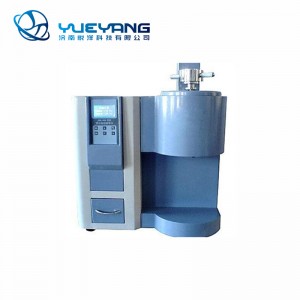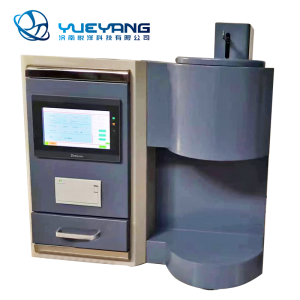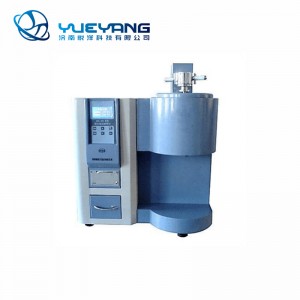


YYP-400E Melt Flow Indexer(MFR)
Structure and Working Principle:
The melt flow rate tester is a type of extrusion plastic meter. Under specified temperature conditions, the sample to be tested is heated to a molten state by a high-temperature furnace. The molten sample is then extruded through a small hole of a specified diameter under the load of a prescribed weight. In the plastic production of industrial enterprises and the research of scientific research institutions, the “melt (mass) flow rate” is often used to represent the fluidity, viscosity and other physical properties of polymer materials in the molten state. The so-called melt index refers to the average weight of each section of the extruded sample converted to the extrusion amount in 10 minutes.
The melt (mass) flow rate instrument is denoted by MFR, with the unit being: grams per 10 minutes (g/min).
The formula is:
MFR(θ, mnom) = tref . m / t
Where: θ —- test temperature
Mnom— - nominal load (Kg)
m —- average mass of the cut-off, g
tref —- reference time (10 minutes), S (600s)
t ——- time interval of the cut-off, s
Example:
A group of plastic samples were cut every 30 seconds, and the results of the mass of each section were: 0.0816 grams, 0.0862 grams, 0.0815 grams, 0.0895 grams, 0.0825 grams.
The average value m = (0.0816 + 0.0862 + 0.0815 + 0.0895 + 0.0825) ÷ 5 = 0.0843 (grams)
Substitute into the formula: MFR = 600 × 0.0843 / 30 = 1.686 (grams per 10 minutes)