


Products
-

YYP-50KN Electronic Universal Testing Machine (UTM)
1. Overview
The 50KN Ring Stiffness Tensile Testing Machine is a material esting device with leading domestic technology. It is suitable for physical property tests such as tensile, compressive, bending, shearing, tearing and peeling of metals, non-metals, composite materials and products. The test control software uses the Windows 10 operating system platform, featuring a graphical and image-based software interface, flexible data processing methods, modular VB language programming methods, and safe limit protection functions. It also has the functions of automatic generation of algorithms and automatic editing of test reports, which greatly facilitate and improve the debugging and system redevelopment capabilities. It can calculate parameters such as yield force, elastic modulus, and average peeling force. It uses high-precision measuring instruments and integrates high automation and intelligence. Its structure is novel, technology is advanced, and performance is stable. It is simple, flexible and easy to maintain in operation. It can be used by scientific research departments, colleges and universities, and industrial and mining enterprises for mechanical property analysis and production quality inspection of various materials.
2. Main Technical Parameters:
2.1 Force Measurement Maximum load: 50kN
Accuracy: ±1.0% of the indicated value
2.2 Deformation (Photoelectric Encoder) Maximum tensile distance: 900mm
Accuracy: ±0.5%
2.3 Displacement Measurement Accuracy: ±1%
2.4 Speed: 0.1 - 500mm/min
2.5 Printing Function: Print maximum strength, elongation, yield point, ring stiffness and corresponding curves, etc. (Additional printing parameters can be added as per user requirements).
2.6 Communication Function: Communicate with the upper computer measurement control software, with automatic serial port search function and automatic processing of test data.
2.7 Sampling Rate: 50 times/s
2.8 Power Supply: AC220V ± 5%, 50Hz
2.9 Mainframe Dimensions: 700mm × 550mm × 1800mm 3.0 Mainframe Weight: 400kg
-

YY-KND200 Automatic Kjeldahl Nitrogen Analyzer
- Product Introduction:
Kjeldahl method is a classical method for nitrogen determination. Kjeldahl method is widely used to determine nitrogen compounds in soil, food, animal husbandry, agricultural products, feed and other materials. The sample determination by Kjeldahl method requires three processes: sample digestion, distillation separation and titration analysis
YY-KDN200 automatic Kjeldahl nitrogen analyzer is based on classic Kjeldahl nitrogen determination method developed sample automatic distillation, automatic separation and analysis of “nitrogen element” (protein) through external related technology analysis system, its method, manufacturing in line with the “GB/T 33862-2017 full (half) automatic Kjeldahl nitrogen analyzer” manufacturing standards and international standards.
-

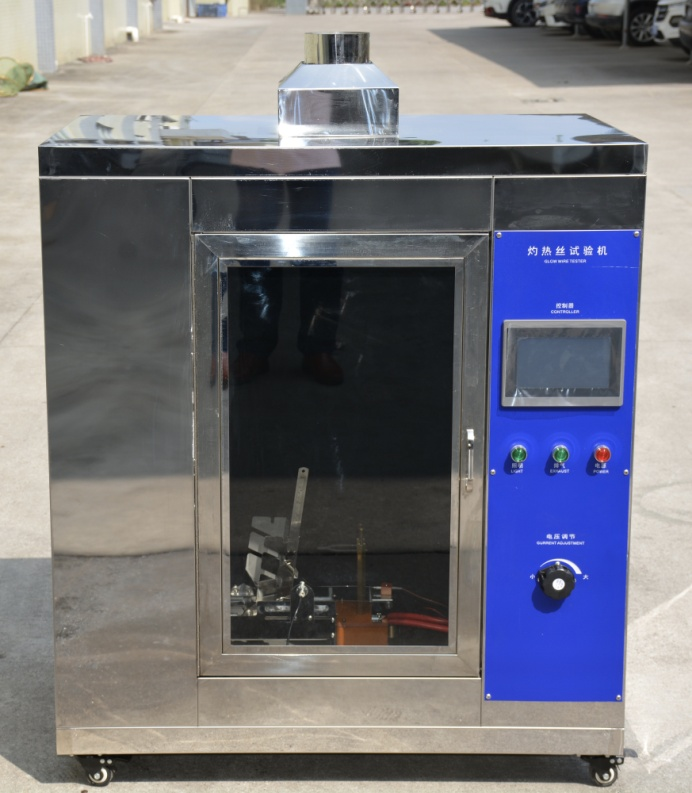
YY-ZR101 Glow Wire Tester
I. Equipment name: Glow Wire Tester
II.Equipment model:YY-ZR101
III.Equipment Introductions:
The glow wire tester will heat the specified material (Ni80/Cr20) and shape of the electric heating wire (Φ4mm nickel-chromium wire) with high current to the test temperature (550℃ ~ 960℃) for 1min, and then vertically burn the test product for 30s at the specified pressure (1.0N). Determine the fire risk of electrical and electronic equipment products according to whether the test products and bedding are ignited or held for a long time; Determine the ignitability, ignitability temperature (GWIT), flammability and flammability index (GWFI) of solid insulating materials and other solid combustible materials. The glow-wire tester is suitable for the research, production and quality inspection departments of lighting equipment, low-voltage electrical appliances, electrical instruments, and other electrical and electronic products and their components.
IV.Technical parameters:
1. Hot wire temperature: 500 ~ 1000℃ adjustable
2. Temperature tolerance: 500 ~ 750℃ ±10℃, > 750 ~ 1000℃ ±15℃
3. Temperature measuring instrument accuracy ±0.5
4. Scorching time: 0-99 minutes and 99 seconds adjustable (generally selected as 30s)
5. Ignition time: 0-99 minutes and 99 seconds, manual pause
6. Extinguish time: 0-99 minutes and 99 seconds, manual pause
Seven. Thermocouple: Φ0.5/Φ1.0mm Type K armored thermocouple (not guaranteed)
8. Glowing wire: Φ4 mm nickel-chromium wire
9. The hot wire applies pressure to the sample: 0.8-1.2N
10. Stamping depth: 7mm±0.5mm
11. Reference standard: GB/T5169.10, GB4706.1, IEC60695, UL746A
twelve Studio volume: 0.5m3
13. External dimensions: 1000mm wide x 650mm deep x 1300mm high.
-

YY-JF3 Oxygen Index Tester
I.Scope of application:
Applicable to plastics, rubber, fiber, foam, film and textile materials such as combustion performance measurement
II.Technical parameters:
1. Imported oxygen sensor, digital display oxygen concentration without calculation, higher accuracy and more accurate, range 0-100%
2. Digital resolution: ±0.1%
3. The measuring accuracy of the whole machine: 0.4
4. Flow regulation range: 0-10L/min (60-600L/h)
5. Response time: < 5S
6. Quartz glass cylinder: Inner diameter ≥75㎜ high 480mm
7. Gas flow rate in the combustion cylinder: 40mm±2mm/s
8. Flow meter: 1-15L/min (60-900L/H) adjustable, precision 2.5
9. Test environment: Ambient temperature: room temperature ~ 40℃; Relative humidity: ≤70%;
10. Input pressure: 0.2-0.3MPa (note that this pressure cannot be exceeded)
11. Working pressure: Nitrogen 0.05-0.15Mpa Oxygen 0.05-0.15Mpa Oxygen/nitrogen mixed gas inlet: including pressure regulator, flow regulator, gas filter and mixing chamber.
12. Sample clips can be used for soft and hard plastics, textiles, fire doors, etc
13. Propane (butane) ignition system, flame length 5mm-60mm can be freely adjusted
14. Gas: industrial nitrogen, oxygen, purity > 99%; (Note: Air source and link head user own).
Tips: When the oxygen index tester is tested, it is necessary to use not less than 98% of the industrial grade oxygen/nitrogen each bottle as the air source, because the above gas is a high-risk transport product, can not be provided as the oxygen index tester accessories, can only be purchased at the user’s local gas station. (In order to ensure the purity of the gas, please purchase at the local regular gas station)
15.Power requirements: AC220 (+10%) V, 50HZ
16. Maximum power: 50W
17. Igniter: there is a nozzle made of a metal tube with an inner diameter of Φ2±1mm at the end, which can be inserted into the combustion cylinder to ignite the sample, the flame length: 16±4mm, the size is adjustable
18. Self-supporting material sample clip: it can be fixed on the position of the shaft of the combustion cylinder and can vertically clamp the sample
19. Optional: Sample holder of non-self-supporting material: it can fix two vertical sides of the sample on the frame at the same time (suitable for textile film and other materials)
20.The base of the combustion cylinder can be upgraded to ensure that the temperature of the mixed gas is maintained at 23℃ ~ 2℃
III.Chassis structure :
1. Control box: The CNC machine tool is used to process and form, the static electricity of the steel spray box is sprayed, and the control part is controlled separately from the test part.
2. Combustion cylinder: high temperature resistance high quality quartz glass tube (inner diameter ¢75mm, length 480mm) Outlet diameter: φ40mm
3. Sample fixture: self-supporting fixture, and can hold the sample vertically; (Optional non-self-supporting style frame), two sets of style clips to meet different test requirements; Pattern clip splice type, easier to place pattern and pattern clip
4. The diameter of the tube hole at the end of the long rod igniter is ¢2±1mm, and the flame length of the igniter is (5-50) mm
IV.Meeting the standard:
Design standard:
GB/T 2406.2-2009
Meet the standard:
ASTM D 2863, ISO 4589-2, NES 714 ; GB/T 5454 ;GB/T 10707-2008 ; GB/T 8924-2005; GB/T 16581-1996 ;NB/SH/T 0815-2010 ;TB/T 2919-1998; IEC 61144-1992 ISO 15705-2002; ISO 4589-2-1996;
Note: Oxygen sensor
1. Introduction of oxygen sensor: In the oxygen index test, the function of the oxygen sensor is to convert the chemical signal of combustion into an electronic signal displayed in front of the operator. The sensor is equivalent to a battery, which is consumed once per test, and the higher the user’s frequency of use or the higher the oxygen index value of the test material, the higher the oxygen sensor will have a higher consumption.
2. Maintenance of oxygen sensor: Excluding normal loss, the following two points in maintenance and maintenance help to extend the service life of oxygen sensor:
1). If the equipment does not need to be tested for a long time, the oxygen sensor can be removed and the oxygen storage can be isolated by a certain means at a lower temperature. The simple operation method can be properly protected with plastic wrap and placed in the refrigerator freezer.
2). If the equipment is used at a relatively high frequency (such as a service cycle interval of three or four days), at the end of the test day, the oxygen cylinder can be turned off for one or two minutes before the nitrogen cylinder is turned off, so that the nitrogen is filled in other mixing devices to reduce the ineffective reaction of the oxygen sensor and oxygen contact.
V.Installation condition table: Prepared by users
Space requirement
Overall size
L62*W57*H43cm
Weight(KG)
30
Testbench
Work bench not less than 1 m long and not less than 0.75 m wide
Power requirement
Voltage
220V±10% 、50HZ
Power
100W
Water
No
Gas supply
Gas: industrial nitrogen, oxygen, purity > 99%; Matching double table pressure reducing valve (can be adjusted 0.2 mpa)
Pollutant description
smoke
Ventilation requirement
The device must be placed in a fume hood or connected to a flue gas treatment and purification system
Other test requirements
-

YY-JF5 Automatic Oxygen Index Tester
- Product features
1. Full-color touch screen control, just set the oxygen concentration value on the touch screen, the program will automatically adjust to the oxygen concentration balance and emit a beep sound prompt, eliminating the trouble of manual adjustment of oxygen concentration;
2. The step proportional valve greatly improves the control accuracy of the flow rate, and the closed-loop control is used to automatically adjust the oxygen concentration drift program in the test to the target value, avoiding the disadvantages of the traditional oxygen index meter that can not adjust the oxygen concentration in the test, and greatly improves the test accuracy.
II.Relevant technical parameters:
1. Imported oxygen sensor, digital display oxygen concentration without calculation, higher accuracy and more accurate, range 0-100%.
2. Digital resolution: ±0.1%
3. Measurement accuracy: 0.1 level
4. Touch screen setting program automatically adjusts oxygen concentration
5. One-click calibration accuracy
6. One key matching concentration
7. Oxygen concentration stability automatic warning sound
8. With timing function
9. Experimental data can be stored
10. Historical data can be queried
11. Historical data can be cleared
12. You can choose whether to burn 50mm
13. Air source fault warning
14. Oxygen sensor fault information
15. Incorrect connection of oxygen and nitrogen
16. Oxygen sensor aging tips
17. Standard oxygen concentration input
18. Combustion cylinder diameter can be set (two common specifications are optional)
19. Flow regulation range: 0-20L/min (0-1200L/h)
20. Quartz glass cylinder: Choose one of two specifications (inner diameter ≥75㎜ or inner diameter ≥85㎜)
21. Gas flow rate in the combustion cylinder: 40mm±2mm/s
22. Overall dimensions: 650mm×400×830mm
23. Test environment: Ambient temperature: room temperature ~ 40℃; Relative humidity: ≤70%;
24. Input pressure: 0.25-0.3MPa
25. Working pressure: nitrogen 0.15-0.20Mpa Oxygen 0.15-0.20Mpa
26. Sample clips can be used for soft and hard plastics, all kinds of building materials, textiles, fire doors, etc
27. Propane (butane) ignition system, the ignition nozzle is made of a metal tube, with an inner diameter of Φ2±1mm nozzle at the end, which can be freely bent. Can be inserted into the combustion cylinder to ignite the sample, the flame length: 16±4mm, the size of 5mm to 60mm can be freely adjusted,
28. Gas: industrial nitrogen, oxygen, purity > 99%; (Note: Air source and link head are provided by the user)
Tips: When the oxygen index tester is tested, it is necessary to use not less than 98% of the industrial grade oxygen/nitrogen each bottle as the air source, because the above gas is a high-risk transport product, can not be provided as the oxygen index tester accessories, can only be purchased at the user’s local gas station. (In order to ensure the purity of the gas, please purchase at the local regular gas station)
- Power requirements: AC220 (+10%) V, 50HZ
- Maximum power: 150W
31.Self-supporting material sample clip: it can be fixed on the position of the shaft of the combustion cylinder and can vertically clamp the sample
32. Optional: non-self-supporting material sample clip: can fix two vertical sides of the sample on the frame at the same time (applied to soft non-self-supporting materials such as textiles)
33.The base of the combustion cylinder can be upgraded to ensure that the temperature of the mixed gas is maintained at 23℃ ~ 2℃ (contact sales for details)
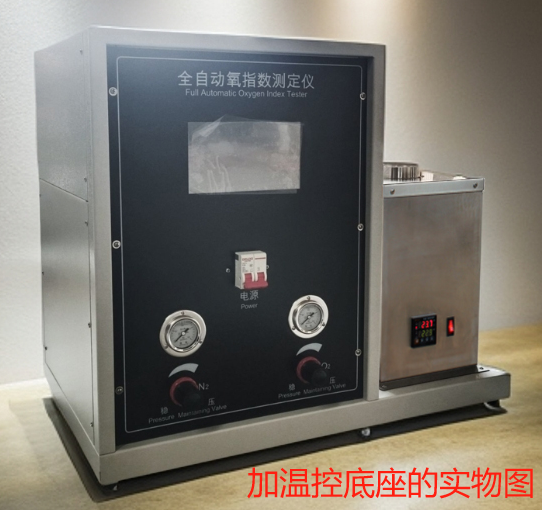
Physical diagram of temperature control base
III.Meeting the standard:
Design standard: GB/T 2406.2-2009
Note: Oxygen sensor
1. Introduction of oxygen sensor: In the oxygen index test, the function of the oxygen sensor is to convert the chemical signal of combustion into an electronic signal displayed in front of the operator. The sensor is equivalent to a battery, which is consumed once per test, and the higher the user’s frequency of use or the higher the oxygen index value of the test material, the higher the oxygen sensor will have a higher consumption.
2. Maintenance of oxygen sensor: Excluding normal loss, the following two points in maintenance and maintenance help to extend the service life of oxygen sensor:
1). If the equipment does not need to be tested for a long time, the oxygen sensor can be removed and the oxygen storage can be isolated by a certain means at a lower temperature. The simple operation method can be properly protected with plastic wrap and placed in the refrigerator freezer.
2). If the equipment is used at a relatively high frequency (such as a service cycle interval of three or four days), at the end of the test day, the oxygen cylinder can be turned off for one or two minutes before the nitrogen cylinder is turned off, so that the nitrogen is filled in other mixing devices to reduce the ineffective reaction of the oxygen sensor and oxygen contact.
IV.Installation condition table:
Space requirement
Overall size
L65*W40*H83cm
Weight(KG)
30
Testbench
Work bench not less than 1 m long and not less than 0.75 m wide
Power requirement
Voltage
220V±10% 、50HZ
Power
100W
Water
No
Gas supply
Gas: industrial nitrogen, oxygen, purity > 99%; Matching double table pressure reducing valve (can be adjusted 0.2 mpa)
Pollutant description
smoke
Ventilation requirement
The device must be placed in a fume hood or connected to a flue gas treatment and purification system
Other test requirements
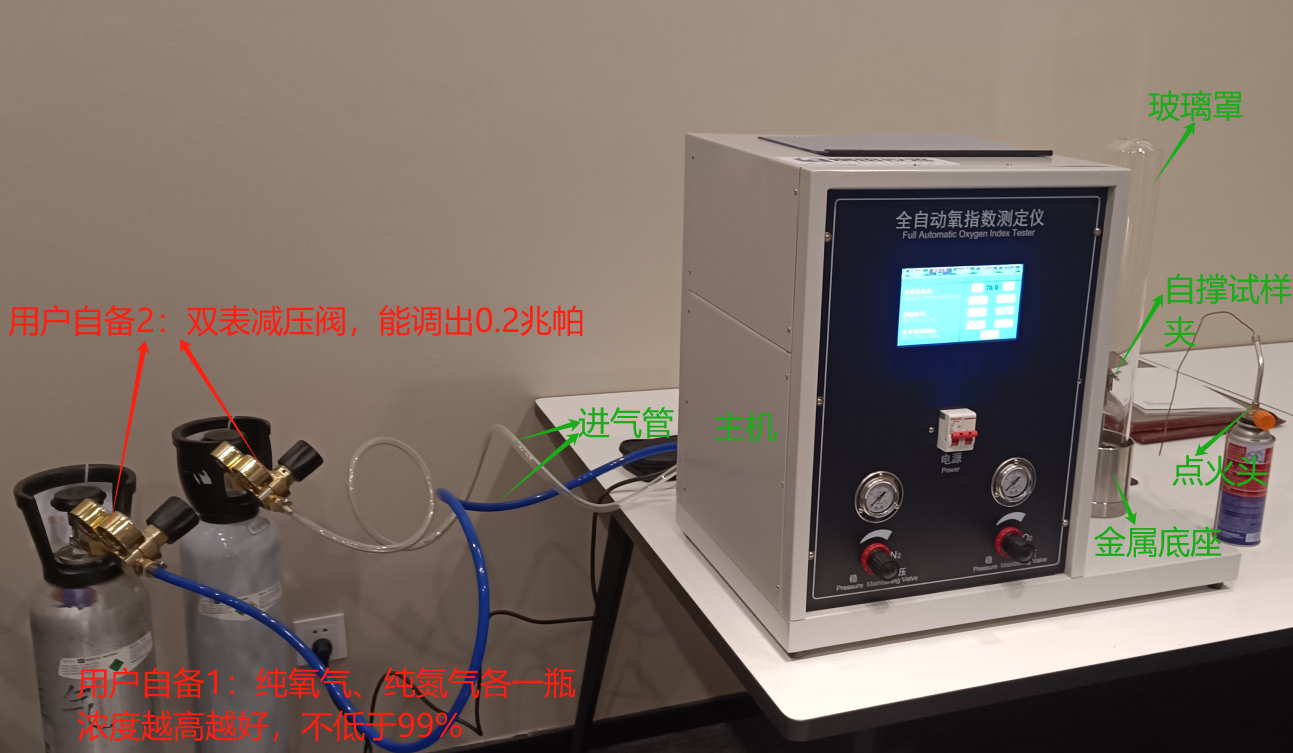
Dual gauge pressure reducing valve for cylinder (0.2 mpa can be adjusted)
V. Physical display:
Green parts together with the machine,
Red parts prepared by users own
-

YYP 4207 Comparative Tracking Index(CTI)
Equipment Introduction:
The rectangular platinum electrodes are adopted. The forces exerted by the two electrodes on the sample are 1.0N and 0.05N respectively. The voltage can be adjusted within the range of 100~600V (48~60Hz), and the short-circuit current is adjustable within the range of 1.0A to 0.1A. When the short-circuit leakage current is equal to or greater than 0.5A in the test circuit, the time should be maintained for 2 seconds, and the relay will act to cut off the current, indicating that the sample is unqualified. The time constant of the drip device can be adjusted, and the drip volume can be precisely controlled within the range of 44 to 50 drops/cm3 and the drip time interval can be adjusted within the range of 30±5 seconds.
Meeting the standard:
GB/T4207、GB/T 6553-2014、GB4706.1 ASTM D 3638-92、IEC60112 、UL746A
Testing principle:
The leakage discharge test is conducted on the surface of solid insulating materials. Between two platinum electrodes of a specified size (2mm × 5mm), a certain voltage is applied and a conductive liquid of a specified volume (0.1% NH4Cl) is dropped at a fixed height (35mm) at a fixed time (30s) to evaluate the leakage resistance performance of the insulating material surface under the combined action of electric field and humid or contaminated medium. The comparative leakage discharge index (CT1) and the leakage resistance discharge index (PT1) are determined.
Main technical indicators:
1. Chamber volume: ≥ 0.5 cubic meters, with a glass observation door.
2. Chamber material: Made of 1.2MM thick 304 stainless steel plate.
3. Electrical load: The test voltage can be adjusted within 100 ~ 600V, when the short-circuit current is 1A ± 0.1A, the voltage drop should not exceed 10% within 2 seconds. When the short-circuit leakage current in the test circuit is equal to or greater than 0.5A, the relay operates and cuts off the current, indicating that the test sample is unqualified.
4. Force on the sample by two electrodes: Using rectangular platinum electrodes, the force on the sample by the two electrodes is 1.0N ± 0.05N respectively.
5. Dropping liquid device: The height of the liquid dropping can be adjusted from 30mm to 40mm, the size of the liquid drop is 44 ~ 50 drops / cm3, the time interval between liquid drops is 30 ± 1 seconds.
6. Product features: The structural components of this test box are made of stainless steel or copper, with copper electrode heads, which are resistant to high temperature and corrosion. The liquid drop counting is accurate, and the control system is stable and reliable.
7. Power supply: AC 220V, 50Hz
-

YY-1000B Thermal Gravimetric Analyzer(TGA)
Features:
- Industrial level widescreen touch structure is rich in information, including setting temperature, sample temperature, etc.
- Use the gigabit network line communication interface, the universality is strong, the communication is reliable without interruption, supports the self-recovery connection function.
- The furnace body is compact, temperature rise and fall speed adjustable.
- Water bath and heat insulation system, insulation high temperature furnace body temperature on the weight of the balance.
- Improved installation process, all adopt mechanical fixation; the sample support rod can be replaced flexibly and crucible can be matched with various models according to the requirements, so that users can have different requirements.
- The flow meter automatically switches two gas flows, fast switching speed and short stable time.
- Standard samples and charts are provided to facilitate customer calibration of constant temperature coefficient.
- Software support each resolution screen, automatically adjust the computer screen size curve display mode. Support laptop, desktop; Support WIN7, WIN10, win11.
- Support user edit device operation mode according to actual needs to achieve full automation of measurement steps. The software provides dozens of instructions, and users can flexibly combine and save each instruction according to their own measurement steps. Complex operations are reduced to one-click operations.
- One-piece fixed furnace body structure, without lifting up and down, convenient and safe, the rate of rising and falling can be adjusted arbitrarily.
- The removable sample holder can meet different requirements after replacement to facilitate cleaning and maintenance after sample contamination.
- The equipment adopts the cup-type balance weighing system according to the principle of electromagnetic balance.
Parameters:
- Temperature range: RT~1000℃
- Temperature resolution: 0.01℃
- Heating rate: 0.1~80℃/min
- Cooling rate: 0.1℃/min-30℃/min(When more than 100℃, can lower the temperature at a cooling rate)
- Temperature control mode: PID temperature control
- Balance weighing range:2g (not the weight range of the sample)
- Weight resolution: 0.01mg
- Gas control:Nitrogen, Oxygen (automatic switching)
- Power: 1000W, AC220V 50Hz or customize other standard power sources
- Communication methods: Gigabit gateway communications
- Standard crucible size(High * diameter) : 10mm*φ6mm。
- Replaceable support, convenient for disassembly and cleaning, and can be replaced with crucible of different specifications
- Machine size: 70cm*44cm*42 cm, 50kg (82*58*66cm, 70kg, with the outer packing).
Configuration list:
- Thermogravimetric analysis – 1set
- Ceramic crucibles(Φ6mm*10mm)– 50pcs
- Power cords and a Ethernet cable — 1set
- CD (contains software and operations video) — 1pcs
- Software-key —- 1pcs
- Oxygen tube, nitrogen airway tube and exhaust tube—each 5meter
- Operation manual — 1pcs
- Standard sample—(contains 1g CaC2O4·H2O and 1g CuSO4)
- Tweezer 1pcs, screwdriver1pcs and medicine spoons 1pcs
- Custom pressure reducing valve joint and quick joint 2pcs
- Fuse— 4pcs
-

DSC-BS52 Differential scanning calorimeter(DSC)
Summary:
The DSC is a touch screen type, specially testing polymer material oxidation induction period test, customer one-key operation, software automatic operation.
Conforming the following standards:
GB/T 19466.2- 2009/ISO 11357-2:1999
GB/T 19466.3- 2009/ISO 11357-3:1999
GB/T 19466.6- 2009/ISO 11357-6:1999
Features:
Industrial level widescreen touch structure is rich in information, including setting temperature, sample temperature, oxygen flow, nitrogen flow, differential thermal signal, various switch states, etc.
USB communication interface, strong universality, reliable communication, support self-restoring connection function.
The furnace structure is compact, and the rate of rising and cooling is adjustable.
The installation process is improved, and the mechanical fixation method is adopted to completely avoid the contamination of the internal colloidal of the furnace to the differential heat signal.
The furnace is heated by electric heating wire, and the furnace is cooled by circulating cooling water (refrigerated by compressor)., compact structure and small size.
The double temperature probe ensures the high repeatability of the sample temperature measurement, and adopts the special temperature control technology to control the temperature of the furnace wall to set the temperature of the sample.
The gas flow meter automatically switches between two channels of gas, with fast switching speed and short stable time.
Standard sample is provided for easy adjustment of temperature coefficient and enthalpy value coefficient.
Software support each resolution screen, automatically adjust the computer screen size curve display mode. Support laptop, desktop; Support Win2000, XP, VISTA, WIN7, WIN8, WIN10 and other operating systems.
Support user edit device operation mode according to actual needs to achieve full automation of measurement steps. The software provides dozens of instructions, and users can flexibly combine and save each instruction according to their own measurement steps. Complex operations are reduced to one-click operations.
-

YY-1000A Thermal expansion coefficient tester
Summary:
This product is suitable for measuring the expansion and shrinkage properties of metal materials, polymer materials, ceramics, glazes, refractories, glass, graphite, carbon, corundum and other materials during the process of heat roasting under high temperature. The parameters such as linear variable, linear expansion coefficient, volume expansion coefficient, rapid thermal expansion, softening temperature, sintering kinetics, glass transition temperature, phase transition, density change, sintering rate control can be measured.
Features:
- 7 inch industrial grade widescreen touch structure, display rich information, including set temperature, sample temperature, expansion displacement signal.
- Gigabit network cable communication interface, strong commonality, reliable communication without interruption, support self-recovery connection function.
- All metal furnace body, compact structure of furnace body, adjustable rate of rise and fall.
- Furnace body heating adopts silicon carbon tube heating method, compact structure, and small volume, durable.
- PID temperature control mode to control linear temperature rise of furnace body.
- The equipment adopts high temperature resistant platinum temperature sensor and high precision displacement sensor to detect the thermal expansion signal of the sample.
- The software adapts to the computer screen of each resolution and adjusts the display mode of each curve automatically according to the size of the computer screen. Support notebook, desktop; Support Windows 7, Windows 10 and other operating systems.
-

YY-700IIA2-EP Biological Safety Cabinet(desktop)
Product Features:
1. Air curtain isolation design to prevent cross-contamination between the inside and outside. 30% of the air is discharged and 70% is recirculated. Negative pressure vertical laminar flow without the need for installation of pipes.
2. Up and down sliding glass doors that can be positioned freely, easy to operate, and can be fully closed for sterilization. Height limit alarm prompt for positioning.
3. Power output sockets in the working area, equipped with waterproof sockets and drainage interfaces, providing great convenience for operators.
4. Special filters are installed at the exhaust outlet to control emissions and pollution.
5. The working environment is free from pollution leakage. Made of high-quality 304 stainless steel, it is smooth, seamless, and has no dead corners, making it easy to disinfect thoroughly and resistant to corrosion and disinfectant erosion.
6. Controlled by an LED liquid crystal panel, with an internal UV lamp protection device. The UV lamp can only operate when the front window and fluorescent lamp are turned off, and it has a UV lamp timing function.
7. 10° tilt angle, in line with ergonomic design.
-

YY-B2 Series Biosafety Cabinet
Product Characteristics
1. Air curtain isolation design prevents internal and external cross contamination, with 100% air flow discharged, negative pressure vertical flow, and no need to install pipelines.
2. The front glass can be moved up and down allows for arbitrary positioning which is easy to operate, and complete closure for sterilization. The positioning height limit alarm prompts.
3. The power output socket in the work area is equipped with waterproof sockets and sewage outlets, providing great convenience for operators
4. HEPA filter is installed at the exhaust area to control emission pollution
5. The working area is made of high-quality 304 stainless steel, which is smooth, seamless, and has no dead corners. It can be easily and thoroughly disinfected to prevent corrosion and disinfectant erosion.
6. Controlled by an LCD panel with built-in UV light protection device, it can only be opened when the safety door is closed.
7. Equipped with DOP test port and built-in differential pressure gauge.
8. 10 ° inclination angle, in line with human body design concepts.
-

YY-A2 Series Biological Safety Cabinet
Product Features:
1. Air curtain isolation design to prevent cross-contamination between the inside and outside. 30% of the air is discharged and 70% is recirculated. Negative pressure vertical laminar flow without the need for installation of pipes.
2. Up and down sliding glass doors that can be positioned freely, easy to operate, and can be fully closed for sterilization. Height limit alarm prompt for positioning.
3. Power output sockets in the working area, equipped with waterproof sockets and drainage interfaces, providing great convenience for operators.
4. Special filters are installed at the exhaust outlet to control emissions and pollution.
5. The working environment is free from pollution leakage. Made of high-quality 304 stainless steel, it is smooth, seamless, and has no dead corners, making it easy to disinfect thoroughly and resistant to corrosion and disinfectant erosion.
6. Controlled by an LED liquid crystal panel, with an internal UV lamp protection device. The UV lamp can only operate when the front window and fluorescent lamp are turned off, and it has a UV lamp timing function.
7. 10° tilt angle, in line with ergonomic design.
-

YY-PNP Leakage Detector(Microbial invasion method)
Product Introduction:
YY-PNP Leakage Detector(Microbial invasion method) is applicable for the sealing tests of soft packaging items in industries such as food, pharmaceuticals, medical devices, daily chemicals, and electronics. This equipment can conduct both positive pressure tests and negative pressure tests. Through these tests, various sealing processes and sealing performances of samples can be effectively compared and evaluated, providing scientific basis for determining relevant technical indicators. It can also test the sealing performance of samples after undergoing drop tests and pressure resistance tests. It is particularly suitable for the quantitative determination of sealing strength, creep, heat sealing quality, overall bag burst pressure, and sealing leakage performance at the sealing edges of various soft and hard metal, plastic packaging items, and aseptic packaging items formed by various heat sealing and bonding processes. It can also conduct quantitative tests on the sealing performance of various plastic anti-theft bottle caps, medical humidification bottles, metal barrels and caps, overall sealing performance of various hoses, pressure resistance strength, cap body connection strength, disengagement strength, heat sealing edge sealing strength, lacing strength, etc. of indicators; it can also evaluate and analyze the indicators such as compressive strength, burst strength, and overall sealing, pressure resistance, and burst resistance of materials used in soft packaging bags, bottle cap torque sealing indicators, bottle cap connection disengagement strength, stress strength of materials, and the sealing performance, pressure resistance, and burst resistance of the entire bottle body. Compared with traditional designs, it truly realizes intelligent testing: presetting multiple sets of test parameters can significantly improve the detection efficiency.
-

(China)YYP107A Cardboard Thickness Tester
Application Range:
Cardboard thickness tester is specially developed and produced for the thickness of paper and cardboard and some sheet materials with certain tightness characteristics. Paper and cardboard thickness testing instrument is an indispensable testing tool for paper production enterprises, packaging production enterprises and quality supervision departments.
Executive Standard
GB/T 6547,ISO3034, ISO534
-

YYP-LH-B Moving Die Rheometer
- Summary:
YYP-LH-B Moving Die Rheometer conforms to GB/T 16584 “Requirements for determination of vulcanization characteristics of rubber without rotorless vulcanization instrument”, ISO 6502 requirements and the T30, T60, T90 data required by Italian standards. It is used to determine the characteristics of unvulcanized rubber and find out the best vulcanization time of rubber compound. Adopt military quality temperature control module, wide temperature control range, high control accuracy, stability and reproducibility. No rotor vulcanization analysis system using Windows 10 operating system platform, graphical software interface, flexible data processing, modular VB programming method, test data can be exported after the test. Fully embodies the characteristics of high automation. Glass door rising cylinder drive, low noise. It can be used for mechanical properties analysis and production quality inspection of various materials in scientific research departments, colleges and universities and industrial and mining enterprises.
- Meeting Standard:
Standard:GB/T3709-2003. GB/T 16584. ASTM D 5289. ISO-6502; JIS K6300-2-2001
-

YY-3000 Natural Rubber Rapid Plastometer
The YY-3000 Rapid Plasticity Meter is used to test the fast plastic value (initial plastic value P0) and plastic retention (PRI) of natural raw and unvulcanized plastics (rubber mixes). The instrument consists of one host, one punching machine (including a cutter), one high-precision aging oven and one thickness gauge. The rapid plasticity value P0 was used to rapidly compress the cylindrical sample between two parallel compacted blocks to a fixed thickness of 1mm by the host. The test sample was kept in the compressed state for 15s to achieve the temperature balance with the parallel plate, and then a constant pressure of 100N±1N was applied to the sample and kept for 15s. At the end of this stage, the test thickness accurately measured by the observation instrument is used as a measure of plasticity. used to test the fast plastic value (initial plastic value P0) and plastic retention (PRI) of natural raw and unvulcanized plastics (rubber mixes). The instrument consists of a main machine, a punching machine (including a cutter), a high-precision aging test chamber and a thickness gauge. The rapid plasticity value P0 was used to rapidly compress the cylindrical sample between two parallel compacted blocks to a fixed thickness of 1mm by the host. The test sample was kept in the compressed state for 15s to achieve the temperature balance with the parallel plate, and then a constant pressure of 100N±1N was applied to the sample and kept for 15s. At the end of this stage, the test thickness accurately measured by the observation instrument is used as a measure of plasticity.
-

YYP203C Thin Film Thickness Tester
I.Product Introduction
YYP 203C film thickness tester is used to test the thickness of plastic film and sheet by mechanical scanning method, but empaistic film and sheet is not available.
II.Product features
- Beauty surface
- Reasonable structure design
- Easy to operate
-

YY-SCT-E1 Packaging Pressure Tester(ASTM D642, ASTM D4169, TAPPI T804, ISO 12048)
Product introduction
YY-SCT-E1 packaging pressure performance tester is suitable for various plastic bags, paper bags pressure performance test, in line with the standard “GB/T10004-2008 packaging composite film, bag dry composite, extrusion composite” test requirements.
Scope of application:
Packaging pressure performance tester is used to determine the pressure performance of various packaging bags, can be used for all food and drug packaging bags pressure test, used for paper bowl, carton pressure test.
The product is widely used in food and drug packaging bag production enterprises, pharmaceutical packaging material production enterprises, pharmaceutical enterprises, quality inspection systems, third-party testing institutions, colleges and universities, research institutes and other units.
-

YY-E1G Water Vapor Transmission Rate (WVTR) Tester
Product Brief Introduction:
It is suitable for measuring the water vapor permeability of high barrier materials such as plastic film, aluminum foil plastic film, waterproof material and metal foil. Expandable test bottles, bags and other containers.
Meeting the standard:
YBB 00092003、GBT 26253、ASTM F1249、ISO 15106-2、 TAPPI T557、 JIS K7129ISO 15106-3、GB/T 21529、DIN 53122-2、YBB 00092003
-

YY-D1G Oxygen Transmission Rate (OTR) tester
Product Introduction:
Automatic oxygen transmittance tester is a professional, efficient, intelligent high-end test system, suitable for plastic film, aluminum foil plastic film, waterproof materials, metal foil and other high barrier material water vapor penetration performance. Expandable test bottles, bags and other containers.
Meeting the standard:
YBB 00082003、GB/T 19789、ASTM D3985、ASTM F2622、ASTM F1307、ASTM F1927、ISO 15105-2、JIS K7126-B